
Cambridge reports: The appeal of science in schools, by Hannah Hennings

Preparing for a language exam could represent a challenging process, but fructuous at the same time. In the process of developing language skills, many great ideas and topics are developed. Hence, our magazine offers the best works that were presented during the English exam preparations.
Hannah Hennings is a 16 years old student from the south of Germany. She likes being around her friends as well as reading fantasy novels (favourite author: Sarah J. Maas). Baking is one of her passions and sweetening other people’s day makes her happy. French is her favourite language, but she also speaks English and a little Spanish. At the moment, she is preparing for the Cambridge exam C1 and therefore she has joined the CAE club of her High school. For practice, she wrote the following essay. And of course also because she chose advanced biology for her final graduation and wants more people to do so.
The appeal of science in schools
At schools, the scientific subjects are losing more and more of their interest among the pupils.
Physics and chemistry courses are made out to be boring and way too difficult. This report assesses
the necessity and importance of science in schools.
The appeal of science in my school
As many students might not know why to choose scientific subjects in school, I will now give some
motivating facts which might be interesting to those students, concerning their further scholar life.
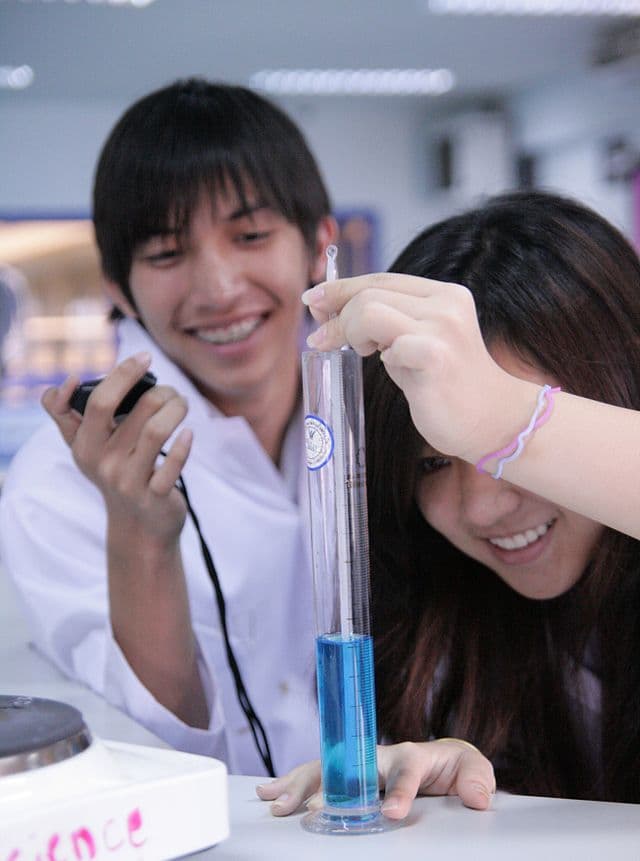
To begin with, I want to say that our school is very well equipped with scientific material to work
with. We have lasers, motors, magnets for physics, many chemicals and tools in chemistry and
modern models of anything in biology. We actually do a lot of practical work. However, some
students still think that science works only with theories. The classes are not at all boring, but
interesting and useful for a later career.
Furthermore, most science teachers at our school are very kind and pass on their passion for science
to their students. It is always great to work with people who enjoy their job.
In addition to scientific subjects, the school also offers some science clubs. That might be about
astronomy or special animals. Those clubs are very often considered nerdy among the students
and thus there are rarely more than a handful of people. This is not at all reasonable, because
science is interesting, and those clubs can be very fun and fascinating. It is something very different
from usual classes.
Why do only very few students want to become scientists?
That the number of students heading for a scientific career decrease is a matter of fact we could
observe for the past few years. That might be because of the bad reputation of science in school
among students. Science is often considered very difficult. Many pupils are convinced that they
can never succeed in physics if they are bad at chemistry. Of course, all the natural sciences are related,
but nevertheless, it is possible to concentrate on one aspect of the world of sciences. The pupils have
to have the chance which science suits them and which doesn’t.
Also in films and other media, there is a bad image of scientists. Very often they are shown as crazy
and strange, without “human feelings”. This is a very important factor for this problem as media
becomes more and more important in our modern society.

How to attract them?
To encourage young people to follow a scientific path for their profession, schools play an important
role as scholar education leaves its mark on all of us at a young age.
To increase the popularity of science in school, students should be shown the importance of this
sector of our culture which has accompanied humanity since its very first steps. Science opens a door
to a variety of professions and it is the science that will lead us into the future. To show this to the
pupils it is necessary to promote the scientific subjects. Maybe there could be more clubs, or maybe
there could be “testing periods” for younger students introduced, where they can get to know the
way of working scientifically and discover new things.
Another suggestion of mine would be that the school could start cooperation with universities or
technical schools, to show the students where their place after graduation could be or what being a
scientist really means.
Publicat în Fără categorie
Nicio persoană nu a recomandat încă
Recomandă acest articolCategorii: Fără categorie
Etichete: Cambridge, cambridge reports, reports, science, science in schools
Răspunsuri(1)
wow, hannah really convinced me to consider a scientific path for my education. This sounds interesting and i believe that science could actually be fun. (everything but chemistry) Thank you for your inspiring article! (:
Doar utilizatorii autentificați pot lăsa comentarii.
După trimitere, comentariul trebuie aprobat înainte să apară public.